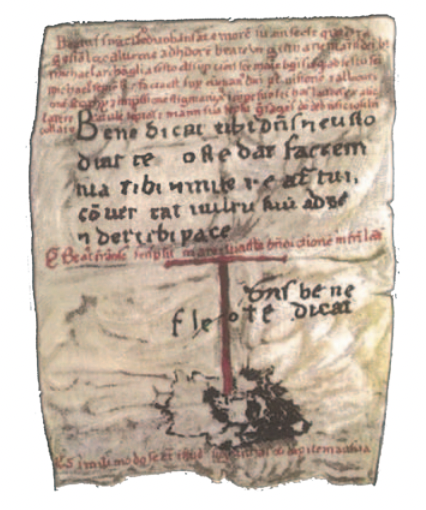
Tau Series: Presentation of the Text of the Rule
The 2nd installment of a series presenting the depth of the Franciscan Tradition in an easily digestible format. Continue Reading Tau Series: Presentation of the Text of the Rule

The 2nd installment of a series presenting the depth of the Franciscan Tradition in an easily digestible format. Continue Reading Tau Series: Presentation of the Text of the Rule
The 1st installment of a series presenting the depth of the Franciscan Tradition in an easily digestible format. Continue Reading Tau Series: The Volterra Letter – The First Letter to All the Faithful
The Roots of Franciscan Christocentrism and Its Implications for Today. Responding to the need for shorter articles for use in the classroom or in adult education groups, this series of CFIT publications provides four-page synopses of important articles by noted scholars on key elements of the Franciscan tradition. Continue Reading Custodians of the Tradition: Christ, Word of God and Exemplar of Humanity
Franciscans realize that they are neither monastic nor apostolic and claim for themselves the description “evangelical.” The rediscovery of the evangelical form of life has emerged from a systematic reflection on the experience of Franciscan living in the light of the early sources, which include not only the writings and hagiographical texts of Francis and Clare but also the writings of great theologians of the Order. Because of the contemporary focus on ministry, there is reluctance to associate “doing” with “theology.” Thus, we dichotomize what was an integral experience of Christian living. Continue Reading Custodians of the Tradition: It Pleases Me That You Should Teach Sacred Theology – Franciscans Doing Theology
Francis as “vernacular theologian” [one whose writing and life demonstrates that all persons can experience God in the midst of the world, and communicate this for the ordinary person] was “not simply a religious genius who sparked an evangelical renewal movement that would come to include great thinkers, but also as one who himself forged new understandings of God and of God’s relation to the world.” Continue Reading Custodians of the Tradition: Francis as Vernacular Theologian – A link to the Franciscan Intellectual Tradition?
Regarding the Third Order Regular Rule, specifically Chapter IX. The first paragraph in the Chapter speaks about the necessary commandment — love of God — as the source for the apostolic life. The manner of the apostolic life is peacemaking. This means that, in being a presence one is offering a transformative presence to the world. Finally, the goal of the apostolic life is to give praise and glory to God. All of one’s deepest desires and the desires of the human heart converge around this inspiration that is the heart of this Rule. Chapter IX is all about the heart: centered on the heart, written on the heart, flowing from the heart. Continue Reading Custodians of the Tradition: The One Thing Necessary – Seeing Chapter IX of the Third Order Regular Rule through the Lens of the Teachings of John Duns Scotus
Franciscan spirituality and theology has long taken an approach that finds its creative insights from the spirituality of St. Francis and St. Clare. Their spirituality led the great theologians of the Franciscan movement to develop a style that has a number of distinctive traits. This is particularly true in the area of Christology. Continue Reading Custodians of the Tradition: Selected Writings – Christ through the Eyes of Francis and Clare
A theologian is the one who contemplates and scrutinizes visible and invisible reality, using the Word of God as a starting point — then Francis is both. What he allows us to glimpse in his writings authorizes us to say that he proposes an authentic general outline of a theology whose center is the Trinitarian God in love with the human person. Continue Reading Custodians of the Tradition: Francis of Assisi “Theologian?”
We are heirs to an intellectual patrimony that spans eight centuries, with a worldview that can offer fresh responses to questions posed in our society and church today. We have resources to share, and a responsibility to share them with those who are searching for “good news” in our day. Continue Reading Custodians of the Tradition: A Franciscan Language for the 21st Century
The value of Thomas Aquinas, the thirteenth-century Dominican theologian, may perhaps lay not so much in the answers he offered for certain questions, but rather in the questions he raised and the way in which he raised them. I would like to make something of the same argument for John Duns Scotus. I suggest that we look at Scotus not so much for original and new answers to contemporary questions (although there are certainly original insights in Scotus, as I will note later), but rather for the manner in which Scotus viewed all that exists. Continue Reading Custodians of the Tradition: John Duns Scotus – Retrieving a Medieval Thinker for Contemporary Theology